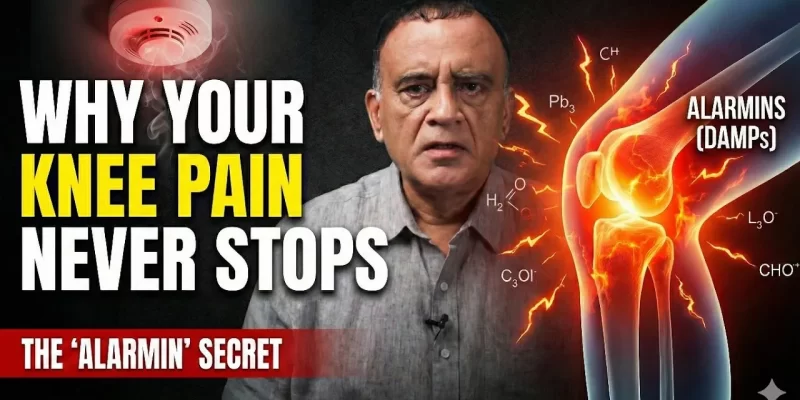
Why Knee Pain Persists: Understanding Alarmins — Your Joint’s “Chemical SOS Signals”

For years, patients have been told that knee pain is simply a matter of “wear and tear.”

But modern orthobiologics, immunology, and molecular pain science reveal a deeper, far more actionable truth:

Your knee is not a mechanical part that erodes like an old tyre.

It is a living organ that communicates.

And when it is distressed, it sends out chemical screams.

These molecules are called Alarmins—and understanding them may completely change the way you think about osteoarthritis, chronic inflammation, and long-standing knee pain.

At Madras Rejuvenation Centre, our clinical protocols for early intervention, inflammatory resolution, and regenerative therapy are increasingly shaped by this emerging science.

What Are Alarmins? The Body’s Internal Danger Signals

Alarmins are endogenous danger-associated molecules released by cells when they are:

stressed

mechanically overloaded

metabolically impaired

damaged by inflammation

exposed to poor tissue nutrition

Common alarmins include:

HMGB1 (High Mobility Group Box 1)

S100 proteins

HSPs (Heat Shock Proteins)

IL-33

Uric acid crystals (from metabolic dysfunction)

These are not foreign invaders like bacteria or viruses.

They are your own tissues’ way of saying:

“I am in trouble. Pay attention.”

When these molecules build up inside the joint, they act as amplifiers, keeping inflammation switched on even when there is no infection and no major injury.

Why Alarmins Keep Knee Inflammation Active

Traditionally, doctors diagnosed osteoarthritis as a structural problem: cartilage thinning, joint space narrowing, or osteophytes.

But these structural changes do not fully explain chronic pain or why symptoms worsen suddenly.

The missing link is failed inflammatory resolution.

Alarmins:

Activate immune cells inside the synovium

Trigger constant production of cytokines

Prevent the joint from returning to a calm, homeostatic state

Sustain a cycle of swelling, stiffness, and pain

This is why patients often say:

“Doctor, my knee is fine some days and horrible on others.”

“I feel a deep, unexplained burning or nerve-like pain.”

“My X-ray hasn’t changed, but my pain has increased.”

These patterns are typical of alarmin-driven inflammation, not wear and tear.

Who Is Most Vulnerable to Alarmin Activity?

Alarmin signalling becomes more aggressive in individuals with:

diabetes or high HbA1c levels

metabolic syndrome / pre-diabetes

obesity or visceral fat deposition

high uric acid levels

chronic stress and cortisol dysregulation

sedentary lifestyles

This is why in your practice, many patients with Type 2 diabetes present with:

disproportionate pain

neurogenic (nerve-like) symptoms

persistent inflammation despite mild radiological OA

This metabolic-inflammatory link is under-recognized but clinically crucial.

Why Treating Pain Alone Never Solves the Real Problem

Most conventional treatments—painkillers, steroid injections, short-term physiotherapy—do not regulate alarmins.

They may reduce symptoms temporarily, but the underlying biochemical distress continues.

To genuinely improve knee health, we must focus on inflammatory resolution, not just suppression.

This includes:

metabolic optimization

targeted anti-inflammatory nutrition

structured movement

regenerative therapies that restore homeostasis

biologics that neutralize alarmin activity

active patient education and self-management

This is the framework used at Madras Rejuvenation Centre in all PRS and orthobiologic strategies.

How Orthobiologics Target Alarmins

Cutting-edge biological treatments aim to:

Reduce alarmin release from stressed or damaged cells

Neutralize existing alarmins in the joint

Reprogram the inflammatory environment toward resolution

Promote tissue recovery instead of degeneration

This is why patients often experience improvements in:

morning stiffness

deep ache

sense of instability

swelling after activity

neurogenic burning sensations

Unlike mechanical treatments, orthobiologics work at the biochemical and molecular level, where alarmins operate.

What This Means for Patients

Understanding alarmins helps patients realize:

Your knee is not “worn out.”

Pain does not always correlate with X-rays.

Inflammation can persist silently for months or years.

Diabetes, high HbA1c, or metabolic dysfunction can worsen knee signals.

Modern treatment must address biological distress, not just structural damage.

This knowledge empowers patients to take control early, before severe degeneration sets in.

Watch the Full Explanation

You can watch the complete video breakdown of alarmins—including visuals, mechanisms, and clinical examples—here on the Madras Rejuvenation Centre YouTube channel.

If you found this useful, explore our related educational resources:

Inflammation & Failed Resolution

Metabolic Factors in Knee Pain

Understanding PRS Treatment

Start Here: The Foundation Video for Knee Health

Final Thoughts

Alarmins are one of the most important concepts in modern pain science.

They help explain why knee pain persists, why standard treatments fail, and why metabolic factors matter more than ever.

At Madras Rejuvenation Centre, our mission is to decode these biological signals and help patients regain mobility, confidence, and long-term health—without unnecessary surgery.

If you experience persistent knee pain, especially with metabolic conditions such as diabetes, consider an evaluation to determine whether alarmins may be contributing to your symptoms.

The Scientific Evidence Behind Inflammation-First Knee Arthritis Care

  1. Scientific Basis of Inflammation-First Knee Arthritis Care

This page summarises the scientific evidence supporting an inflammation-first approach to knee osteoarthritis, as presented in the Inflammation Pillar Video. Each section corresponds directly to a key statement from the script, supported by peer-reviewed research.

1. Knee Arthritis Is Not Just Wear and Tear

Scientific Proof

Osteoarthritis is now recognised as a whole-joint inflammatory disease involving the synovium, cartilage, subchondral bone, ligaments, and infrapatellar fat pad.

Key References

  • Robinson WH et al., Nature Reviews Rheumatology – Osteoarthritis as an inflammatory disease
  • Berenbaum F, Osteoarthritis and Cartilage – Low-grade chronic inflammation in OA progression

Consensus

Mechanical damage alone does not explain pain severity or disease progression.


2. Inflammation Inside the Joint Drives Pain, Stiffness, and Progression

Scientific Proof

  • Synovitis strongly correlates with pain severity
  • Associated with effusion and stiffness
  • Predicts faster cartilage loss

Key References

  • Hill CL et al., Annals of the Rheumatic Diseases
  • Felson DT et al., Arthritis & Rheumatology

Consensus

Pain tracks inflammatory activity, not X-ray grade.


3. Two Patients With the Same X-Ray Can Have Very Different Pain

Scientific Proof

Radiographic severity correlates poorly with clinical symptoms.

Key References

  • Bedson J, Croft PR, Rheumatology
  • Hannan MT et al., Arthritis & Rheumatism

Consensus

Imaging underestimates biological disease activity.


4. Exercise Improves Support, Not Inflammation

Scientific Proof

  • Improves muscle strength and neuromuscular control
  • Does not suppress synovial cytokines when inflammation is active

Key References

  • Henriksen M et al., Osteoarthritis and Cartilage
  • Baker KR et al., Arthritis Care & Research

Consensus

Exercise is necessary but biologically insufficient when inflammation is uncontrolled.


5. Why Patients Plateau Despite Good Physiotherapy

Scientific Proof

  • Active synovitis predicts poor rehabilitation response
  • Associated with pain flares after loading
  • Reduces tolerance to strengthening

Key References

  • Scanzello CR et al., Clinical Orthopaedics and Related Research
  • Schaible HG, Nature Reviews Rheumatology

Consensus

Plateaus are biological, not motivational failures.


6. Painkillers Suppress Symptoms, Not Disease Biology

Scientific Proof

  • NSAIDs reduce pain temporarily
  • Do not halt cartilage degeneration
  • Do not modify disease progression

Key References

  • Zhang W et al., OARSI Guidelines
  • Hochberg MC et al., Arthritis Care & Research

Consensus

Symptom relief does not equal disease control.


7. Sequence Matters: Calm Inflammation Before Strengthening

Scientific Proof

  • Reducing inflammatory load improves pain thresholds
  • Improves exercise tolerance
  • Enhances functional outcomes

Key References

  • Atukorala I et al., Arthritis Research & Therapy
  • Bennell KL et al., British Journal of Sports Medicine

Consensus

Biological readiness determines rehabilitation success.


8. Joint Preservation Focuses on Biology, Not Just Mechanics

Scientific Proof

Modern OA management emphasises early biological modulation, load management, and individualised treatment sequencing.

Key References

  • Loeser RF et al., Osteoarthritis and Cartilage
  • Hunter DJ, The Lancet

Consensus

Joint preservation is proactive, not passive.


9. Inflammation Is Treatable

Scientific Proof

  • Inflammation in OA is measurable
  • Inflammation is modifiable
  • Inflammation is clinically meaningful

Key References

  • Mathiessen A, Conaghan PG, Arthritis Research & Therapy
  • Scanzello CR, Goldring SR, Arthritis & Rheumatology

Consensus

Osteoarthritis inflammation is manageable, not inevitable.

See the video here -https://youtu.be/IJFPdKUwpc0?si=5lN4781-zEmo3Xk0

FAQ’s

Q: Is knee osteoarthritis only caused by wear and tear?

A: No. Current research shows osteoarthritis is a whole-joint inflammatory disease. Mechanical wear alone does not explain pain severity or progression.

Q: Why does knee pain not match X-ray findings?

A: Pain correlates more strongly with synovial inflammation than with radiographic cartilage loss. X-rays underestimate biological disease activity.

Q: Does exercise reduce inflammation in knee arthritis?

A: Exercise improves strength and support but does not reliably suppress active synovial inflammation when it is present.

Q: Why do some patients plateau despite physiotherapy?

A: Active inflammation sensitises pain pathways and limits tolerance to loading, leading to biological—not motivational—plateaus.

Q: Are painkillers disease-modifying in knee arthritis?

A: No. NSAIDs reduce symptoms temporarily but do not alter the underlying disease process or progression.

Knee arthritis cellular therapy India

Knee arthritis cellular therapy India -Dr.A.K.Venkatachalam

Knee arthritis cellular therapy India Dr.A.K.Venkatachalam is shown here. The patient is a 72 year old male who had undergone two previous treatments with bone marrow cellular therapy and arthroscopic washout and lavage. Now he has chosen to undergo fat derived cellular therapy because fat is better than bone marrow as it contains more signalling cells. If you want this procedure, email drvenkat@kneeindia.com.

BMC treatment Knee osteoarthritis Chennai

BMC treatment knee arthritis India

BMC treatment knee arthritis India. Do you want to know what this is all about? Listen to this video.

Listen to this patient’s testimonial here after understanding the above explanation.

If you want to be considered for this treatment, schedule an appointment with the doctor in Chennai by mail at this id. drvenkat@kneeindia.com. Visit www.orthobiologicsurgeryindia.com for more information.

Knee Cartilage repair India

Evidence stem cell treatment Chennai

Last night a doctor asked me for the longest duration of evidence stem cell treatment Chennai in my practiceCases of OA knee from 2004 on whom I performed first generation cell procedures constitute this evidence. I started doing first generation biological procedure by arthroscopy in 2004. There are several patients with early knee osteoarthritis who were able to avoid or postpone a knee replacement by several years. Subsequently they either got a further biological treatment or went in for knee replacement. See the videos below for this evidence. This evidence pre dates some of the stem cell clinics in the US who reported their first cases in 2008. Although it was done by arthroscopy, the scientific basis is the same: of getting the body’s cells to repair the body. If you need more evidence for stem cells, please see the FAQ section.

  1. The first video recorded in 2013 is that of a man who underwent a micro fracture of the knee in 2006. His knee pain was relieved. Only in the year 2013 he had some recurrence and this was further treated by a PRP injection. He has not had any problem in the last two years. He has been able to avoid a knee replacement so far.
    Watch the video from 0.48 to 1.24 for the relevant portion. He says that earlier he had severe knee pain and was unable to stand for even five minutes. He underwent a micro fracture procedure at DAE hospital and this relieved him of pain. Micro fracture is a first generation stem cell procedure. It consists of harvesting cells from the base of the damaged cartilage in the knee. Underlying cells flow into the area and organize to form a super clot. These go on to mature to form a covering layer of fibro cartilage. Pain relief results which can last for several years. The MRI picture is also captured in the video at 1.38 fleetingly.

2. In the second video, a lady underwent a micro fracture of her left knee in the year 2007. Her knee pain began from 2005. She was able to obtain good pain relief and function which lasted up to 2011. She finally decided to get  knee replacement in 2013 which is when this video was recorded. So she was able to manage for six years with a first generation cell procedure known as micro fracture. Watch from 4.16 to 6.37. This video is in Tamil.


So one can note that I have followed up my patients over the years. So seven years is the longest duration  of follow up with cell therapy with in my practice with the first generation technique. This constitutes proof. In fact, this news was also published in The Hindu, an English news paper in 2004 and 2005.